How Managed AWS Hosting Helps Startups Scale Faster
Startups move fast. Whether building a SaaS platform, launching a mobile app, or growing an eCommerce business, speed and scalability often determine success. However, many startups struggle with infrastructure management, server maintenance, downtime, and unexpected traffic spikes as they grow. This is where managed AWS hosting becomes valuable. By combining the power of Amazon Web Services with managed infrastructure services, startups can focus on product development and customer growth instead of dealing with complex cloud operations.
What Is Managed AWS Hosting?
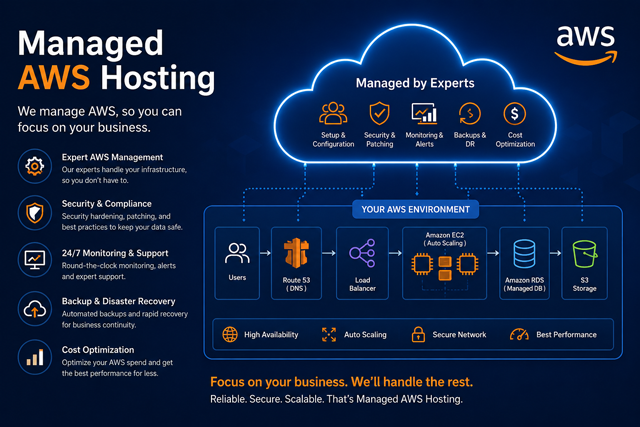
Managed AWS hosting refers to hosting solutions built on AWS infrastructure where most operational tasks are handled by a managed service provider or automated AWS-managed services. These tasks typically include server setup and configuration, monitoring and maintenance, security updates, performance optimization, automatic backups, scaling infrastructure, load balancing and disaster recovery. Instead of manually managing cloud servers, startups gain a streamlined environment optimized for performance and growth.
Why Scalability Matters for Startups
Startups often experience unpredictable growth patterns. A product launch, marketing campaign, or viral social media post can suddenly increase traffic overnight. Traditional hosting environments may struggle under these conditions since the resources are fixed, scaling is slow, downtime risks increase and infrastructure upgrades require manual intervention. Managed AWS hosting solves these problems with cloud-native scalability and automation.
Ways in Which Managed AWS Hosting Helps Startups Scale Faster
Managed AWS hosting helps startups scale faster in the following ways:
1. Rapid Infrastructure Deployment
Time-to-market is critical for startups. Managed AWS hosting allows businesses to deploy infrastructure quickly without spending weeks configuring servers and networking environments. Startups can launch web applications, APIs, SaaS platforms, databases and development environments within hours instead of days.
This speed enables teams to test ideas faster, release MVPs quickly and iterate products continuously.
2. Automatic Scaling During Traffic Spikes
One of AWS’s biggest advantages is elastic scalability. Managed AWS hosting providers typically configure auto scaling groups, load balancers, CDN distribution, and traffic routing. This allows applications to automatically scale resources up or down based on demand.
For startups, this means no server crashes during traffic spikes, better user experience, reduced downtime, and efficient resource utilization. A startup only pays for the infrastructure it actually uses, which is especially important during early growth stages.
3. Reduced DevOps Burden
Managing AWS infrastructure manually requires expertise in Linux administration, networking, security, monitoring, backup management and cloud architecture. Most startups do not have large DevOps teams in their early stages. Managed AWS hosting removes much of this operational complexity by handling server maintenance, OS patching, infrastructure monitoring, security hardening and performance tuning. As a result, developers can spend more time building products instead of managing servers.
4. Better Reliability and Uptime
Downtime can severely damage a startup’s reputation and revenue. Managed AWS environments are often built using high-availability architectures that include multiple availability zones, redundant systems, automated failover, health monitoring and backup recovery systems. These features improve application reliability and ensure consistent uptime even during infrastructure failures. For startups competing in crowded markets, reliability directly impacts customer trust.
5. Cost Optimization for Growing Businesses
Many startups assume cloud hosting is expensive. In reality, managed AWS hosting can reduce costs when properly optimized. Managed providers can help startups choose the right instance sizes, avoid overprovisioning, optimize storage usage, implement auto scaling and monitor unnecessary spending.
AWS’s pay-as-you-go pricing model allows startups to scale gradually without investing heavily in physical infrastructure upfront. This flexibility helps preserve cash flow during early growth stages.
6. Enhanced Security and Compliance
Cybersecurity is a major concern for startups handling customer data, payments, or SaaS platforms. Managed AWS hosting typically includes firewall configuration, DDoS protection, SSL management, security patching, access control policies, backup encryption and threat monitoring. AWS also provides compliance-ready infrastructure that supports GDPR, HIPAA, SOC 2 and PCI DSS standards. This helps startups build secure applications without maintaining large security teams.
7. Faster Global Expansion
As startups grow internationally, performance becomes increasingly important. Managed AWS hosting enables global scalability using content delivery networks (CDNs), multi-region deployments, edge caching and geographic traffic routing. This ensures users experience fast loading times regardless of location. For SaaS startups and global applications, international performance can significantly improve user retention and conversion rates.
8. Improved Performance Optimization
Slow applications reduce customer satisfaction and increase churn. Managed AWS hosting providers often optimize database performance, caching layers, server configurations, CDN delivery, query optimization and resource allocation. These optimizations improve application responsiveness, website speed, API performance and scalability under load. Performance improvements become increasingly important as user traffic grows.
Conclusion
For startups, growth often comes with infrastructure challenges. Scaling servers, maintaining uptime, handling traffic spikes, and securing applications can quickly overwhelm small teams. Managed AWS hosting simplifies these operational complexities by combining AWS’s powerful cloud infrastructure with expert management and automation. The result is a scalable, secure, and high-performance environment that allows startups to focus on what matters most: building products, acquiring customers and accelerating growth.
As competition increases in the digital economy, managed AWS hosting provides startups with the flexibility and reliability needed to scale efficiently and confidently.